
Construction of the Michel-Ange auxiliary building
- Construction site summary
- Impact on customer trips
- Impact on local residents
- Learn more about the project
- Onglet 5
Construction site summary
As part of the Blue line project, this worksite involves building a new operational infrastructure required to operate the métro.
Current step: Vertical excavation of the site of the future auxiliary building
Building this type of underground infrastructure takes a tremendous amount of work. Here are the main steps required to construct the auxiliary building:
Step | Status |
Preparatory work (relocation of underground water mains, sewers and cabling) | Completed |
Mobilization and site setup | Completed |
Vertical excavation of the operational infrastructure site | Completed |
Concreting and construction of the new infrastructure | In progress |
Installation of linings and other architectural elements | Upcoming step |
Installation of mechanical and electrical equipment | Upcoming step |
Exterior design and landscaping | Upcoming step |
Testing and commissioning of equipment | Upcoming step |
Impact on customer trips
No impact on customer trips.
Impact on local residents
In spring 2025, construction of a new auxiliary building began in Michel-Ange Park. The construction zone needed to complete this work is taking up the park’s entire surface area. In order to complete the various stages of the project, the work will be spread out over several years.
 Pedestrian traffic
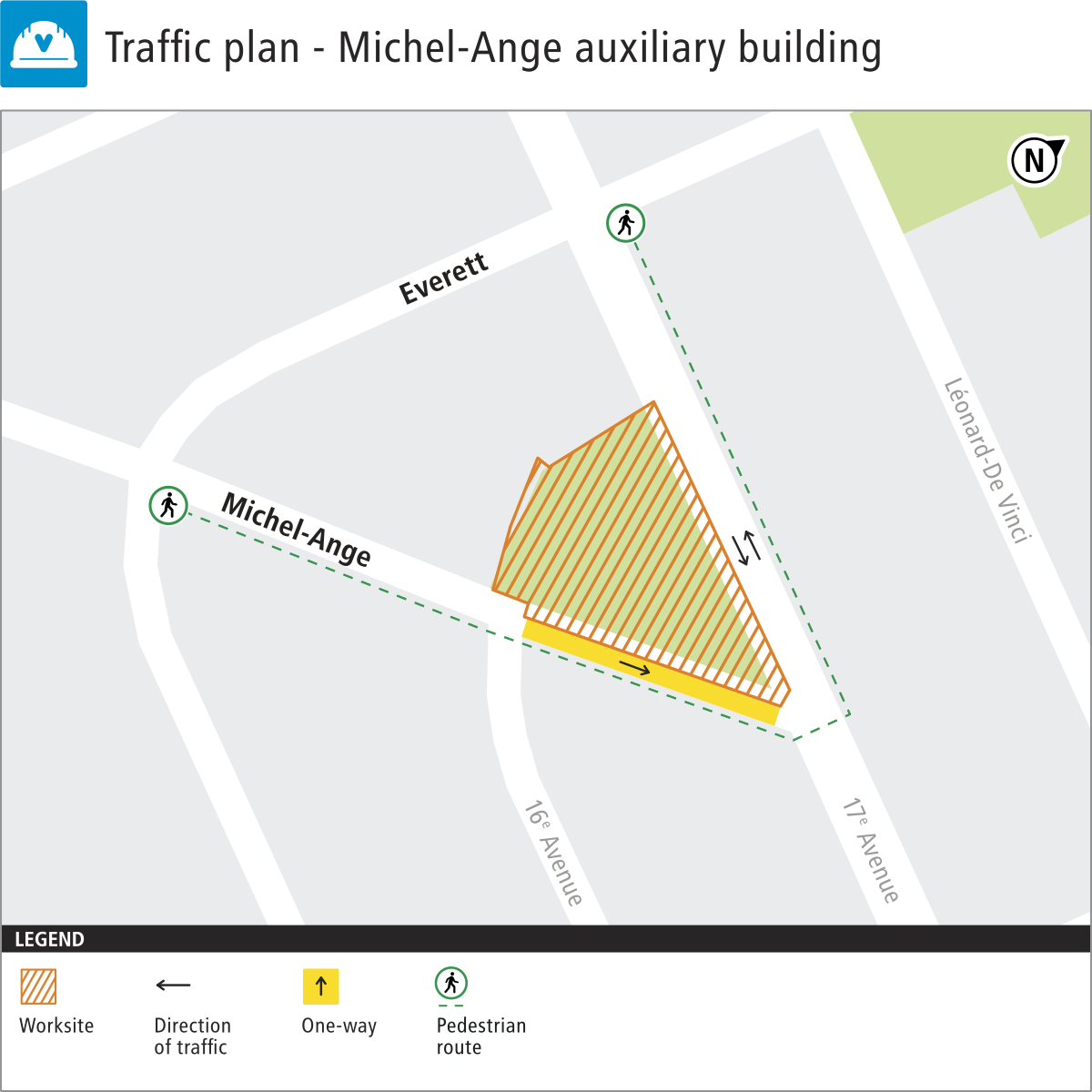
- The sidewalks running along Michel-Ange Park are closed on 17th Avenue and Michel‑Ange Street.
- Pedestrians can use the sidewalk on the other side of the street.
- A universally accessible pedestrian crossing has been set up on the south side of the intersection at Michel‑Ange and 17th.
 Car traffic
- Michel-Ange Street has become one-way southbound, between 16th and 17th Avenues.
- On 17th Avenue, one lane remains open in each direction.
Work on the project site during the weekend
Depending on the progress at the construction site, and to allow us to continue according to the planned timeframe, weekend work may be necessary. This work will take place during the day only.
Changes to street parking
Some parking spots on Michel-Ange Street and 17th Avenue has been removed to allow for construction of the Michel-Ange auxiliary building. Permit parking spots in the area were also relocated.
Street parking was modified in the 17th Avenue/Michel-Ange Street area. These changes were needed to set up the worksite while keeping traffic lanes open on those two streets.

What’s changing
17th Avenue
Parking is prohibited at all times along most of the stretch between Jean-Talon and Everett, except in designated sections for permit holders.
Michel-Ange
Parking is prohibited at all times on both sides of the street between 16th and 17th Avenue.
Relocated permit parking
Some permit parking spots are relocated during the work.
The Zone 51 permit parking spots previously located on 17th Avenue between Jean-Talon and Everett streets are moved to the west side of 17th Avenue, and on Everett near the avenue.
These changes will remain in place throughout construction of the Michel-Ange auxiliary building, which is expected to take several years.
For more information about street and permit parking, visit the City of Montréal website.
Rock excavation work
Work is progressing well on the Michel-Ange auxiliary building site, and we are beginning the rock excavation phase.
Since much of Montréal’s bedrock consists of very hard limestone, the excavation work is particularly challenging. Although we’ve installed noise walls with acoustic insulation around the worksite to help reduce disturbances, the first few months of this phase will be noisy due to the shallow depth of the work. As we dig deeper, the noise levels will go down.

During the first phase of excavation, noise walls can only partially block worksite noise.
As excavation progresses, the noise walls will be more effective, with the shaft walls projecting the sound upwards.
Equipment used
To carry out the excavation, we mainly use drills and rock splitters, which helps reduce the use of jackhammers, as they are noisier.
- Drills are first used to cut the perimeter of the excavation area, then to drill into the rock so that the rock splitter can be inserted.
- Rock splitters are specialized equipment that break the rock from the inside by inserting expandable hydraulic pins into drilled holes. This method creates cracks without vibrations or shock waves, making it quieter.
We understand that this phase can be particularly disruptive for local residents. Rest assured that we're taking all the necessary steps to minimize this temporary inconvenience.
Good to know
- Access to businesses and residences will be maintained at all times.
- Signage will be posted to direct pedestrians, cyclists and drivers.
- Worksite trucks will take 17th Avenue, Jean‑Talon Street and Saint-Michel Boulevard.
- Appropriate mitigation measures will be put in place to reduce the impact on local residents, including noise walls around the worksite perimeter.
parlons·en
Join your local good neighbour committee!
Do you live near the future Michel-Ange auxiliary building area and want to have your say in how the Blue line project worksite will fit into your neighbourhood?
A good neighbor committee has been set up as a space for dialogue between the Blue line extension project team and the local community. We’re currently looking for people who live in the area to complete the committee and represent local residents at a few meetings per year.
Write to us to apply or to find out more.
Learn more about the project
let's chat
Public participation
Information sessions, talks, activities, good neighbour committees: our team wants to meet you!
Information booth
At Le Boulevard Shopping Centre
In the coming months, we’ll be starting excavation work to make way for new infrastructure for the Blue line project.
The excavation method will vary depending on the type of work being done. The surface excavation work will involve controlled microblasting, whereas most of the excavation for the underground tunnel will be done using a tunnel boring machine, or TBM. At both types of worksites, there will also be some mechanical excavation. The vibrations produced by the different excavation methods will be measured on an ongoing basis using seismographs. These devices will be installed at various points throughout the excavation zones and will be used to continuously monitor the vibration levels and make sure they fall within legal limits.
Essential preventive measures
To prepare for upcoming excavation work, the STM has tasked ABS with inspecting buildings that meet at least one of the following criteria:
- Located within 75 metres of any surface-level excavation work
- Located within 30 metres of the tunnel axis
The inspections will serve to compile an inventory of the structures surrounding the worksites for the Blue line project. The findings of the inspections will also be used to establish the maximum vibration levels for each site. Although these inspections are a precautionary measure, they are essential in the unlikely event that the work causes any damage.
Each building inspection lasts approximately 15 to 30 minutes. Photos are taken of the building interior and exterior. The photos are mostly close-ups of the foundations, walls, ceilings, and floors and serve to document the building’s condition prior to the start of the excavation work.
The pre-construction inspection is a common precautionary measure for major construction sites. It protects you in the unlikely event that your property suffers any damage during work on the Blue line project.
In the fall of 2024 and 2025, urban forestry work will take place around the Blue line project worksites. Trees that interfere with the construction sites will be protected, replanted, or cut down. Our team of forest engineers, landscape architects, urban planners, and sustainable development experts has carefully planned these interventions to preserve as many trees as possible.
The goal is to replant the trees wherever possible. Soverdi, the not-for-profit organization overseeing the replanting process, will monitor and care for the trees after they are transplanted to ensure their survival. Trees that can’t be replanted due to their size or condition will be recycled into wood chips, firewood or compost depending on the quality of the wood. The health and species of the trees will also help determine which ones need to be cut down, based on whether they are diseased, subject to borer infestations, or invasive, among other factors.
Michel-Ange auxiliary building sector
Before the start of the construction work, various punctual activities needed to be completed in Michel-Ange Park.
This includes removing some trees, that were cut down in late March 2025, to clear space for the construction site. This had to be done before the start of spring, when birds begin building their nests.
Protective measures for preserved trees
In order to protect the trees that are being preserved on the site, we have excluded the grassy areas surrounding them from the construction zone, thereby ensuring the protection of the trees root systems. These areas are partitioned off with plywood walls to prevent storage activities or the movement of machinery within them.
Ultimately, Blue line project sites will be revegetated and several hundred new trees planted, for a stronger, healthier canopy.
In Michel-Ange Park, a new tree will be planted for every one that is removed. The park will also be completely redeveloped by the end of the work.
For a project of this scale in a residential neighbourhood, we need to adapt our approach and take the environment into account. Here are some examples of concrete steps we’re taking to foster respectful coexistence with the neighbourhood:
- The footprint of the construction area has been minimized to limit traffic disruptions.
- Noise barriers have been installed around the construction site.
- White-noise backup alarms on vehicles also help reduce noise levels.
- Trucks are sprayed down before leaving the site to help limit the spread of dust (except in winter).
To learn more about the PLB's work and the measures put in place, visit the project page.
An auxiliary building is a service building, closed to the public and located between two métro stations, that houses a variety of mechanical and electrical equipment needed for métro operations. This includes ventilation equipment, power supply infrastructure and pumps to remove runoff water. There are currently hundreds of these buildings in the métro network.
The work schedule is tailored to each stage of the project. Our plan is to concentrate activities that generate the most noise during the day, but work may also take place in the evening or at night, seven days a week.
Permitted noise levels are, however, adjusted based on the time of day and the composition of the neighbourhood. At all times, mitigation measures are put in place to reduce noise pollution, and noise levels are also monitored continuously.
The Blue line project construction schedules are planned in accordance with municipal regulations. To accommodate the scope and complexity of the construction sites, the three boroughs concerned by the extension have harmonized their regulations. This enables us to reduce the total duration of construction and help keep the overall project on schedule.
More about the Blue line project
Contenu de l'onglet 5
The project in images

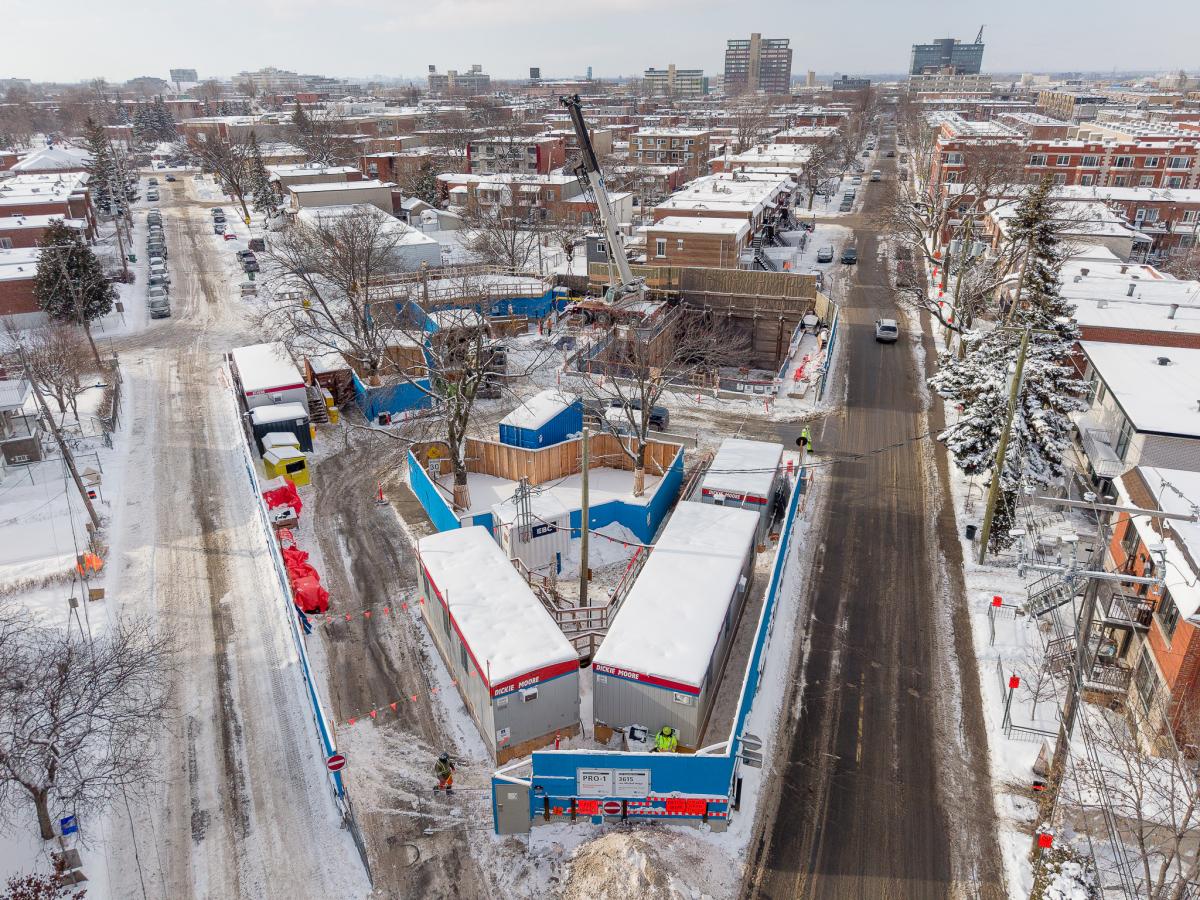
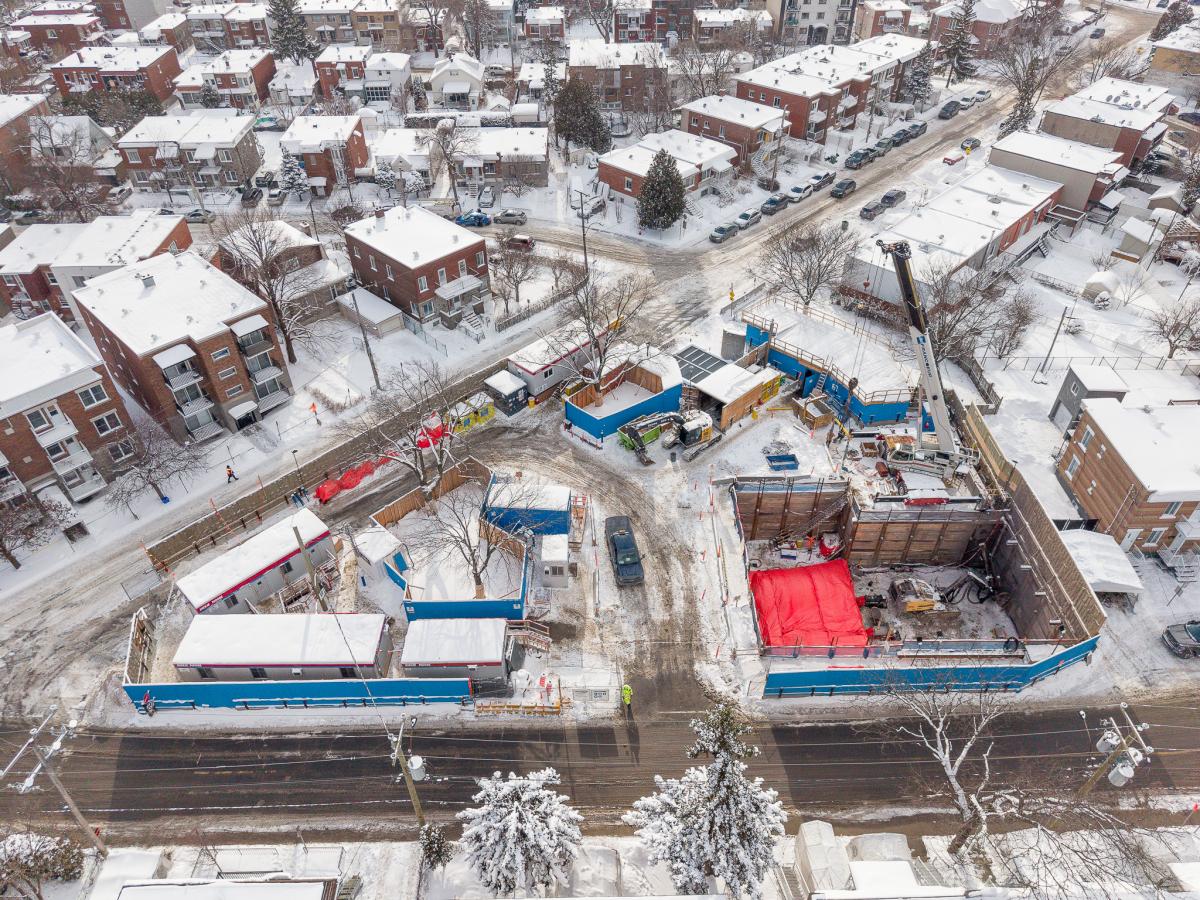
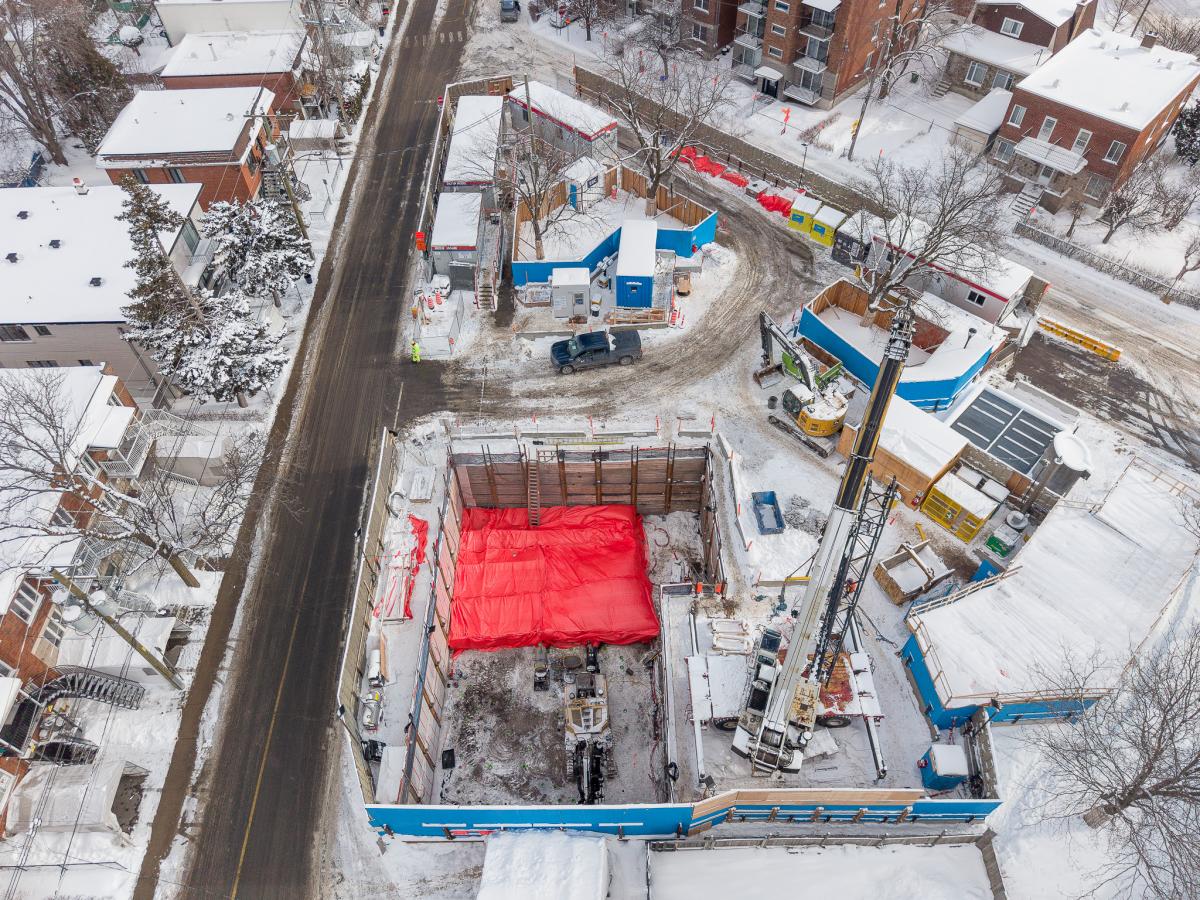
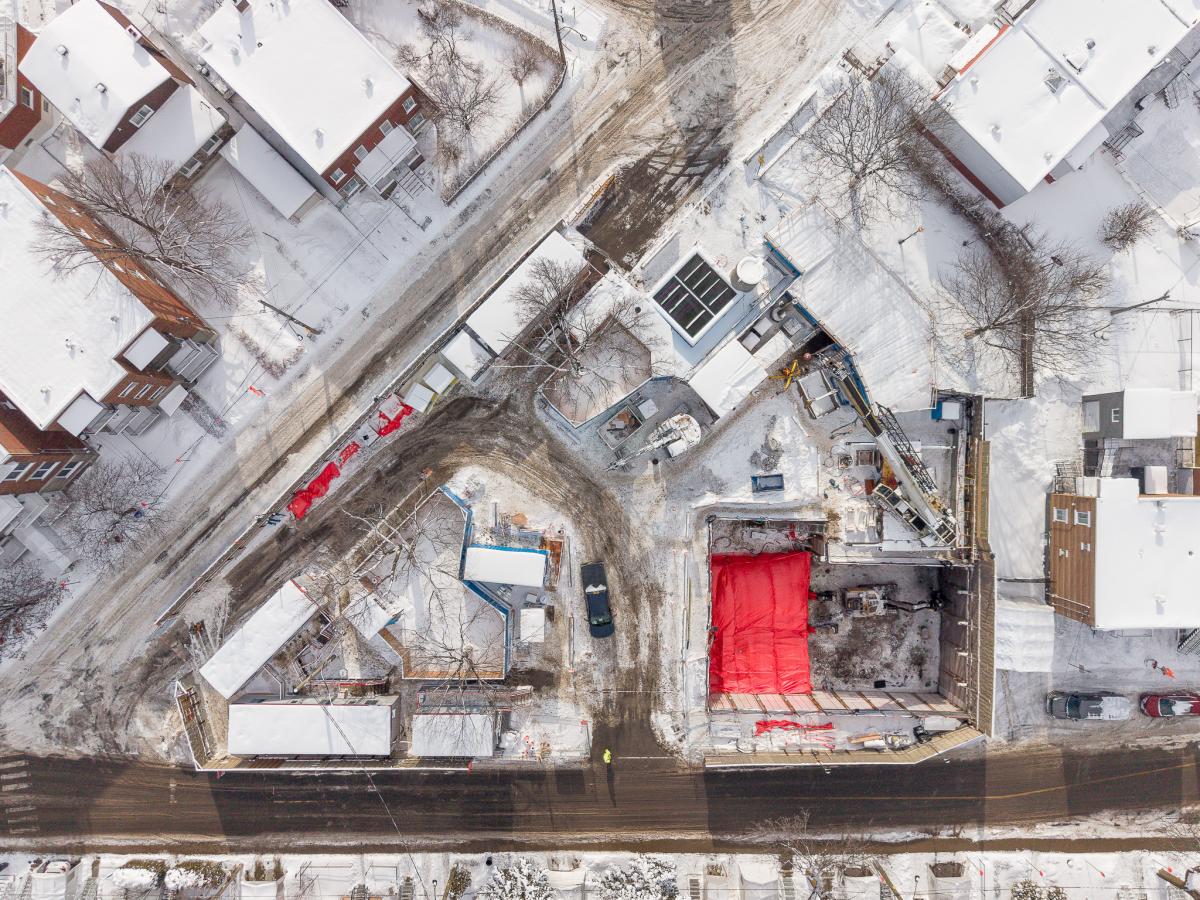
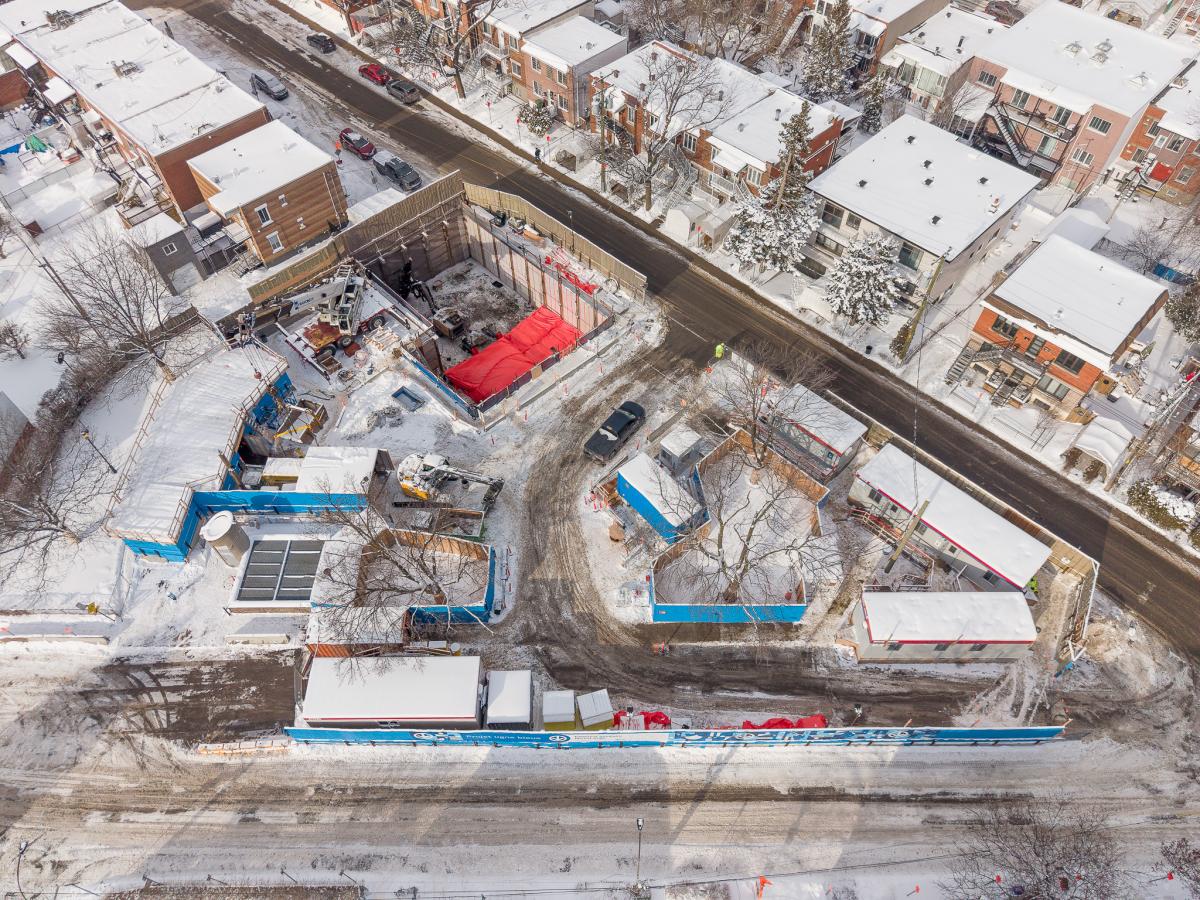
 The construction site in January 2026
 The construction site in January 2026
 The construction site in January 2026
 The construction site in January 2026
 The construction site in January 2026
The Blue line project follows in the wake of the Déclaration du gouvernement du Québec et de la Ville de Montréal to revitalize Montréal East. Many projects are underway to give a new impetus to this sector. Increased mobility, economic development, and improved living environments are at the heart of this ambitious project. For more information, see Québec.ca/RevitalisationEstMontreal (in French only).