
 My Alerts
 Operating hours
Line 2 - Orange
| Towards Montmorency (zone B) | Towards Côte-Vertu | |||
|---|---|---|---|---|
| First | Last | First | Last | |
| Weekdays | 05h43 | 00h43 | 05h53 | 01h07 |
| Saturday | 05h43 | 01h13 | 05h53 | 01h37 |
| Sunday | 05h43 | 00h43 | 05h53 | 01h07 |
After the last métro, you can use the night bus service.
Frequency of departures
Line 2 - Orange
|
Peak
From 7am to 9am and from 4pm to 6pm
|
Non-peak
Morning, day and evening (non-peak)
|
|
|---|---|---|
| Week | Every 2 to 6 minutes | Every 3 to 8 minutes |
| Week-end | Every 6 to 10 minutes | |
Estimated occupancy
Line 2 - Orange
Entrances
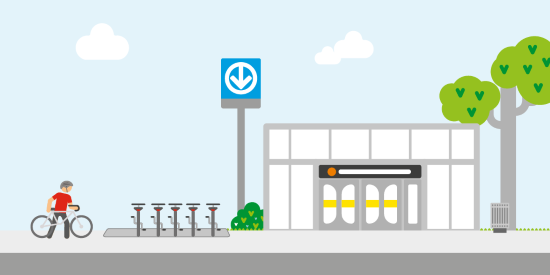
- Accès A - St-Ferdinand, 555, rue St-Ferdinand, H4C 3L7
- Accès B - Place Saint-Henri
- Accès C - Rue Saint-Jacques (Nord) Polyvalente Saint-Henri
Find out more about the station
Inaugurated on April 28, 1980, the station is located in the Saint-Henri district of the Sud-Ouest borough.
Number of bicycle stands available outside the station: 42. First come, first served.
Before taking our public transit system with your bike, please read the Bicycles section for more info.
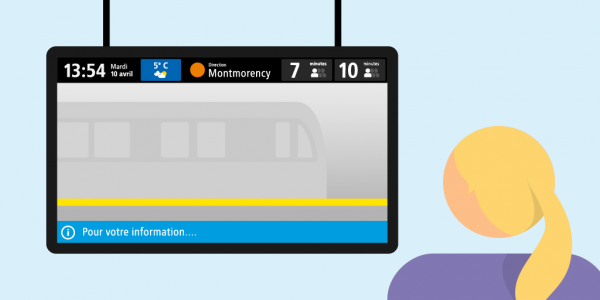
Information screens
This station is equipped with two platform-mounted screens displaying train running times and occupancy in real time. In the event of service disruption, additional information is displayed.
Information terminals
This station is also equipped with a customer information terminal displaying real-time bus schedules. The terminal is located in the Entrance A (Access A) - 555, Saint-Ferdinand street.
To find out more about our Information terminals, click here.

Architects: Julien Hébert & Jean-Louis Lalonde.
Opened: April 1980.
Origin of name: place Saint-Henri, neighbourhood known as the Village des Tanneries (leather tanners) in the 18th century and where, in 1810, the first chapel was built and dedicated to Henry II, Holy Roman Emperor, also known as Saint Henry.
Did you know? This station served as a terminus for the Orange line from April 1980 to September 1981.
Artworks: sculpture by Jacques de Tonnancour, mural by Julien Hébert and statue by Joseph-Arthur Vincent.
 Mobile network available at this station
Accessibility
This is a universally accessible station, with many features designed to enhance your experience.
When traveling, you can call on an STM attendant to help you bridge the gap between the platform and the metro car.
This station is equipped with elevators. Access the station from Entrance B Place Saint-Henri.

You can check the service status of our network's elevators in real time at any time!
Plan your trips around elevator accessibility across the network:

 : possible connection with the 5-Blue line at Jean-Talon and Snowdon métro stations, and with the 1-Green line at Berri-UQAM and Lionel-Groulx métro stations.
 : possible connection with the 2-Orange line at Berri-UQAM and Lionel-Groulx métro stations.
 : possible connection with the 2-Orange line at Jean-Talon and Snowdon métro stations.
 : no connection.
- : only lines 2-Orange and 1-Green are accessible by elevator.
Visit the Elevator access to the métro page to find all accessible stations
Since 2013, textured tiles have been installed on this station's platforms. They can be detected with a cane or foot to indicate the platform edges.

How do I get to the special shuttle in case of a métro service interruption?
Two stops are available at this station and the signs are easily identifiable since they are orange, the color of the métro line they serve.
 Towards
  Henri-Bourassa: Bus stop 51989, located on Saint-Jacques, corner of Saint-Ferdinand.
Towards Laval
To continue towards Laval métro stations ( Cartier, de la Concorde and Montmorency), between 5:30 a.m. and 2 p.m., the special shuttle service is operated by the Société de transport de Laval (STL) from Henri-Bourassa métro station. From 2 p.m. to the closure of the métro, the special shuttle service is operated by the STM and ends its service at Cartier métro station.
- Towards Côte-Vertu: Bus stop 51986, located on Saint-Ferdinand, corner Saint-Jacques.
This shuttle is not free, the regular fare applies.
It is also possible to check these stops on the neighbourhood map displayed at the entrances of our stations.
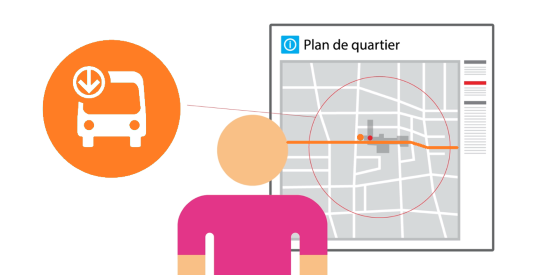
Around this station
Bus transfers
| Local 17 Décarie | South | North |
|---|---|---|
| Local 35 Griffintown | West | East |
| Local 36 Monk | West | East |
| Local 190 Norman | East | West |
| All-night 371 Décarie | South | North |